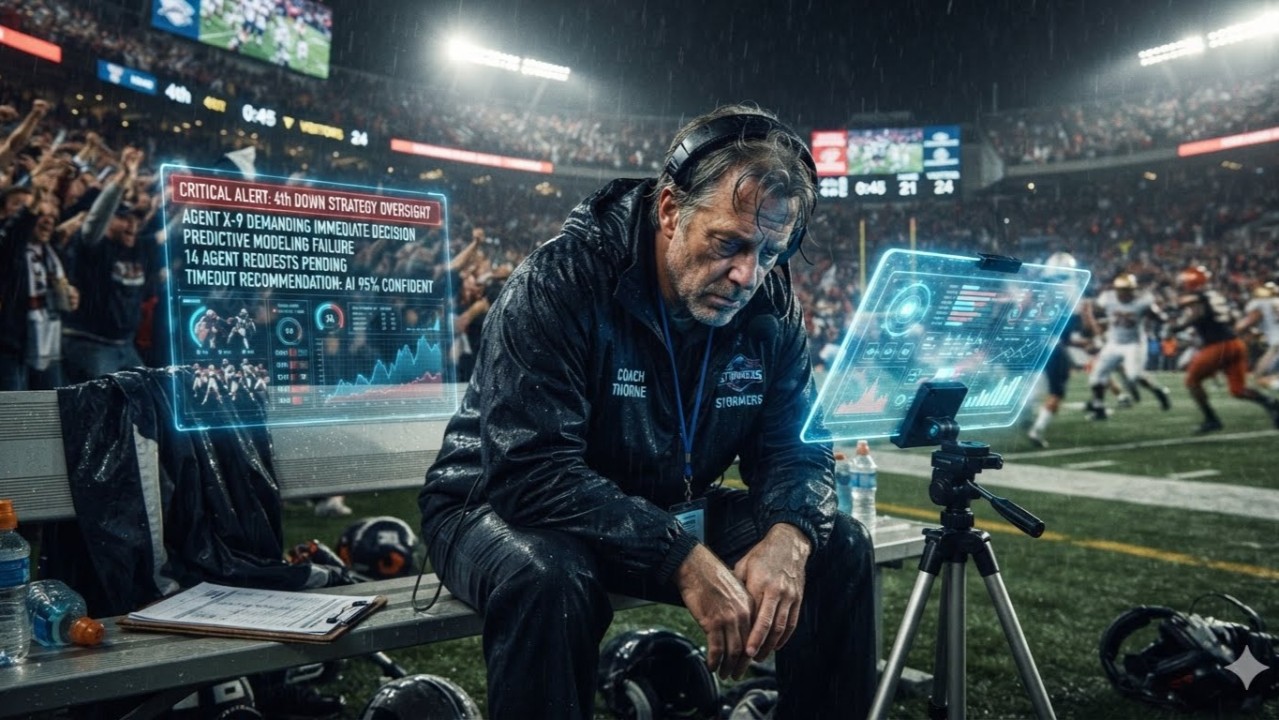
Picture an American football game. You have four downs to move the ball. Between every play there is a huddle, a breath, a moment to read the defense and decide what comes next. The pace is fast, but the game is built around pauses. The thinking happens in the gaps.
Agentic AI just moved the goal post. It sits so close now that the whole field feels collapsible in a single play. So we stop huddling. We snap the ball, snap it again, and again, because everything looks reachable right now. What used to be a four down game with room to think has become a one down game run at a sprint. No huddle. No breath. Just the next snap.
That is where the burnout lives. Not in the tool itself, but in the rhythm it quietly rewrites.
THE TRAP IS THAT IT FEELS LIKE PROGRESS
For employers, agentic AI makes everything attainable. For employees, the promise of agentic AI was that it would give them time back. The early data says the opposite is happening.
A Harvard Business Review study published in February 2026 followed roughly 200 employees at a US technology company for eight months. AI users worked faster, took on a broader range of tasks, and stretched work into more hours of the day, often without anyone asking them to. Eighty three percent of workers said AI increased their workload rather than reducing it. Among associates and entry level staff, more than six in ten reported burnout.
The mechanism is worth sitting with. They called it task expansion. When AI makes writing, coding, or analysis faster, we do not bank the time saved. We spend it on more work. And here is the quiet part: the new speed becomes the new baseline. The rhythm raised expectations for speed, not through anyone issuing a demand, but through what became normal in everyday work.
Other research points the same way. In one 2026 survey, the top fear among knowledge workers was not losing their jobs to AI. It was being expected to do more for the same pay at a pace that cannot hold. Analysts have even coined a term for the fatigue of supervising clusters of agents all day: AI brain fry.
The pattern is consistent. The productivity is real at first. Then it becomes the floor you are measured against, and the floor keeps rising.
WHAT WE LOSE WHEN WE NEVER HUDDLE
Speed is not the enemy. The loss of the pause is.
When every task can start instantly, the space for reflection, judgment, and genuine problem solving gets compressed. We spin up iteration after iteration, proof of concept after proof of concept, before anyone has actually sat down together to ask whether we are building the right thing at all. The machine removed the friction, and the friction was where a lot of our best thinking used to happen.
The first casualty is first principles thinking. First principles means stripping a problem back to what is actually true, questioning every assumption, and reasoning up from the ground rather than copying the shape of what already exists. It is slow by design. It needs the pause. But when the goal post is one snap away, we stop reasoning up from the ground. We ask an agent for the answer and iterate on its output, which quietly means we are iterating on its assumptions instead of examining our own. We look busy and productive while the foundational thinking, the part that actually creates something new, gets skipped.
There is a second cost that gets less attention. Agents are extraordinary at generating output, but they are terrible at carrying context across a company. Knowledge that should be shared stays trapped in individual chats, individual sessions, individual heads. Even sometimes locked behind a subscription if not setup appropriately. Everyone moves fast, and almost nobody moves together. We are producing more and understanding each other less.
THE HARD PART IS THE HUMAN, AND THAT IS THE POINT
The appearance of comfort
This is a transition. What we are living through happened over the span of a few months, not years, and we are all still finding our footing. Everyone agrees, at least in principle, that the human needs to stay in the loop. But for many of us in computer science, the human is exactly the part we find hardest.
I say this as one of us. Many of us are more introverted. Many of us are on the spectrum. And there is a quiet, seductive logic that whispers that if we could just remove the human from the loop, everything would finally run clean. No awkward meetings, no misread rooms, no friction. Just us and the machine, moving fast.
But that instinct is fueling the demons. The very interconnection we are tempted to automate away is the thing we most need. When we push the human out of the loop, we are not just optimizing a workflow. We are pushing away the people, and the connection, that keep us whole. The people who most need that human contact end up engineering it out of their own days, and calling it efficiency.
Keeping the human in the loop is not only good governance. For some of us, it is the harder and braver choice, and it matters most precisely because it is hard.
THE AGENTIC WHIRLPOOL OF DEATH (AWD)
Here is the pattern in its purest form, and if you have done any agentic coding you already know it in your bones.
You hit a problem. Could be hardware, could be software, it does not matter. You bring it to the agent. The agent responds with total confidence: here is the root cause, here is the fix. You try it. It does not work. So you paste the new error back in. The agent, still completely sure of itself, offers a fresh technique, a new angle, another thing to try. You try that one too. It fails. You paste the next error.
And now you are in AWD. Each turn feels like progress because something new is always being offered. The agent never runs out of confident suggestions. So you keep going. One hour. Two. Three. Always one fix away, never actually closer.
The way out is almost embarrassingly simple. You stop. You take one minute and actually look at the problem. You notice you have been circling for three hours and the agent has not moved you an inch. So you reset. You start from first principles, from scratch, on a fresh angle. And then, using the very same agent, you solve it in about five minutes.
That is the whole lesson. The problem was never the agent, and it was never the tools. The problem is that we let ourselves be carried. The whirlpool does not pull you under because the current is strong. It pulls you under because you never stepped out of the water to look at where it was taking you.
THE WARNING, AND THE WAY THROUGH
Before you unleash the beast
So here is my warning. Not a warning against the technology. A warning about how we hold it. How we "harness" it.
Agents are genuinely amazing, and we should use them at will. But that power needs a label on the side, and the label reads: "meet first, think second, submit to agent...third".
Three things I keep coming back to.
Reclaim the thinking time between humans. Before you unleash three agents to build five versions of something, have the conversation. The five minute discussion that shapes the problem is worth more than the fifty iterations that skip it. Acting fast is not the same as moving forward.
Fix the context gap. The biggest unsolved problem in agentic work (currently) is not capability, it is shared understanding. Institutional knowledge. That gray hair employee that sits on a mountain historical knowledge. That project manager that forces touchpoints. That impromptu whiteboard exchange. Until we have better ways to carry context across a team, treat that as a discipline: write things down, share the why, make your reasoning legible to the people around you.
Respect experience. Agents can produce a plausible answer in seconds. They cannot replace the human who has seen this go wrong before, who feels when something is off, who brings calm and ingenuity to a hard call. That kind of judgment is earned, and it is exactly what a one down sprint erodes fastest.
Use the huddle. Talk to each other. Bring your experience, your calm, your ingenuity to the table first.
And then... unleash the beast.